


If you've ever glanced at your child's maths homework and thought, “That's not how I learned to do it,” you're in good company. Many of us were taught different ways to subtract, but today's primary schools focus on a formal written technique called the column method.
Put simply, it’s a way of organising numbers into vertical columns based on their place value (ones, tens, hundreds, etc.). This structured approach makes subtracting everything from simple two-digit numbers to complex, multi-digit figures much clearer and less prone to error.
Why the Column Method is a Big Deal in Primary Maths
The shift to the column method isn't just a change for change's sake. It's now a cornerstone of the UK National Curriculum because it does more than just help children find the right answer - it teaches them how numbers actually work. It forces them to think about place value.
Before a child can even start with column subtraction, they need a rock-solid grasp of place value. They have to understand that in a number like 245, the “2” isn't just a two; it's 200. If your child is a bit shaky on this, it's worth pausing to strengthen their understanding with some place value and number sense activities first.
A Skill Built Over Time
Children aren't thrown in at the deep end. The column method is introduced carefully and built up piece by piece throughout their time at primary school.
Column Subtraction Milestones in the UK Curriculum
| School Year | Age | Key Skill Focus | Example |
|---|---|---|---|
| Year 2 | 6-7 | Informal methods, understanding subtraction as “take away” or “difference”. Using number lines. | 45 - 12 |
| Year 3 | 7-8 | Formal introduction of the column method with up to 3-digit numbers. No borrowing initially. | 368 - 124 |
| Year 4 | 8-9 | Subtraction with up to 4-digit numbers, including borrowing (regrouping). | 4,251 - 1,328 |
| Year 5 | 9-10 | Subtracting larger numbers and introducing decimals (money and measures). | 25.50 - 12.75 |
| Year 6 | 10-11 | Mastering subtraction with large numbers and decimals in preparation for KS2 SATs. | 601.2 - 34.85 |
As you can see, the big moment happens in Year 3. This is when the curriculum officially requires pupils to “add and subtract numbers with up to 3 digits, using formal written methods”.
The whole point is to give your child a logical, repeatable process they can count on. Once they have it down, the steps are the same whether the numbers are small or large.
Laying the Groundwork for Future Maths
Mastering column subtraction isn't just about passing a test. It’s about building the essential scaffolding for all the maths that comes later.
- It reinforces number properties: the method makes children break down and rebuild numbers, strengthening place value and regrouping.
- It prepares them for trickier maths: the same logic applies directly to decimals with money and measurements, and even lays a foundation for algebra.
- It's genuinely useful in real life: from working out change to calculating time differences and recipe measurements.
Mastering Basic Column Subtraction Without Borrowing
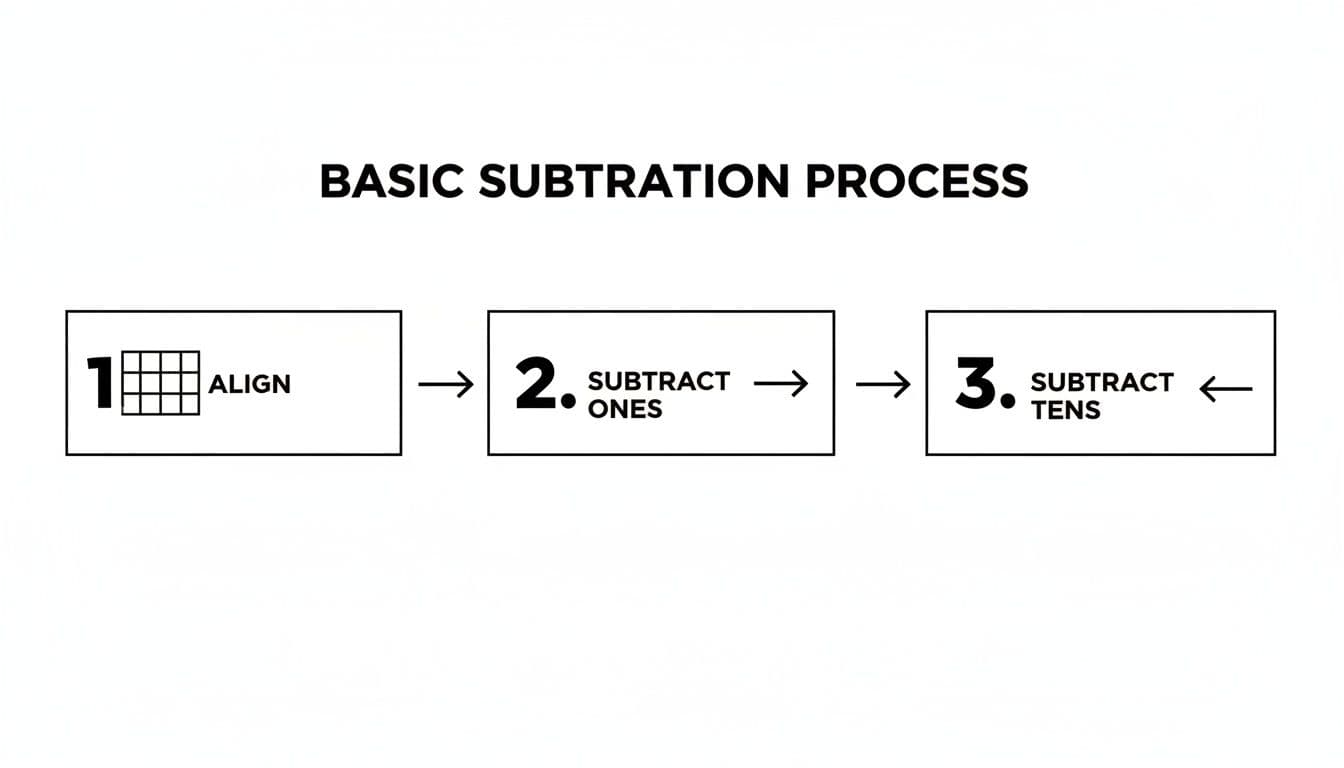
Let's start with the simplest version of column subtraction - the kind that doesn't involve any borrowing. We'll walk through 58 - 23. The first thing to get right is how the sum is laid out on the page.
Setting Up Your Sum
For 58 - 23, we're working with two columns: Tens and Ones. The biggest number must go on top, and the number you're taking away sits directly underneath.
- The 8 (from 58) and the 3 (from 23) line up in the Ones column.
- The 5 (from 58) and the 2 (from 23) line up in the Tens column.
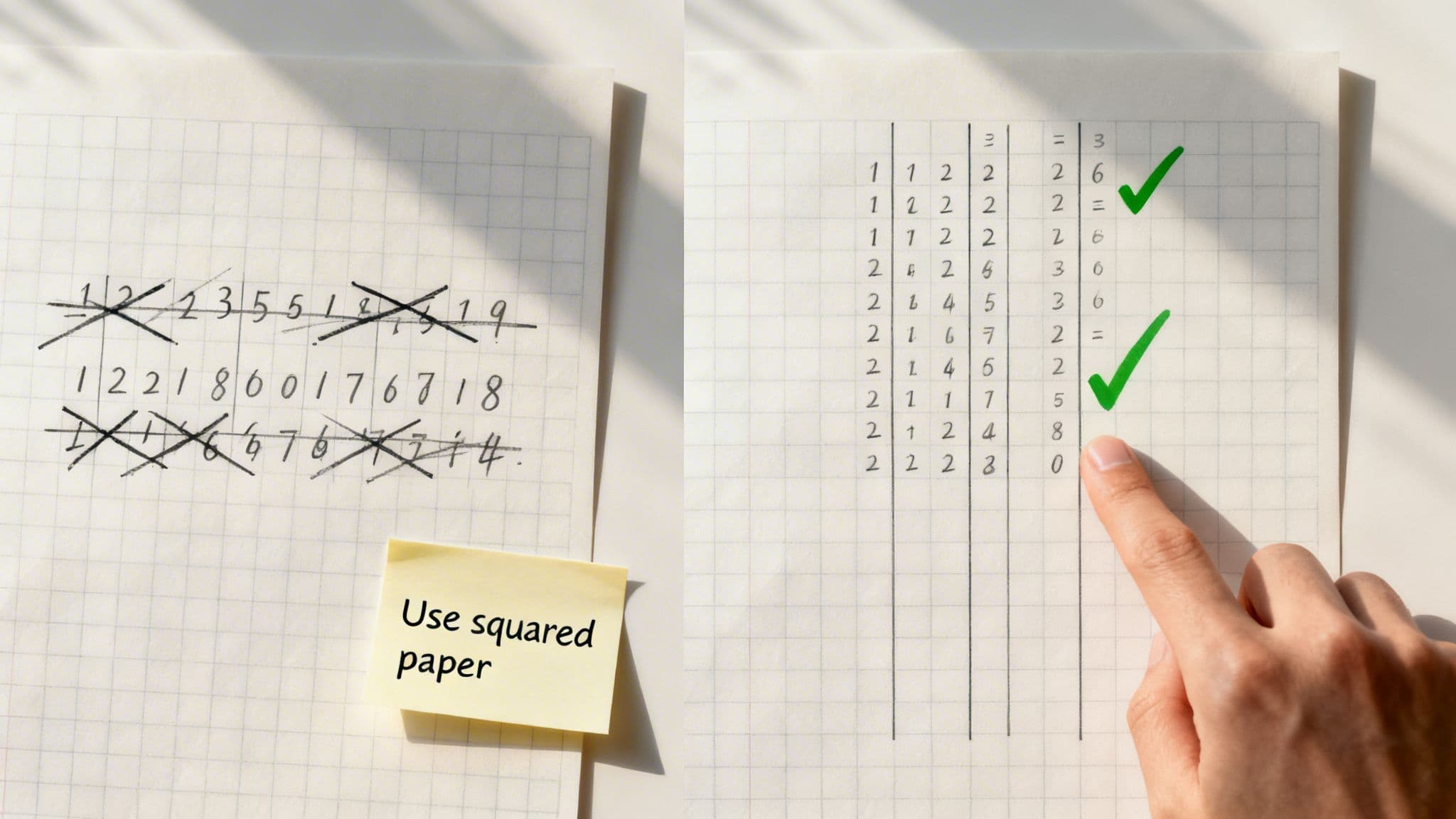
Squared maths paper is a brilliant support. The grid naturally guides alignment, cutting down simple errors.
Working From Right to Left
The golden rule is to always start on the right. Ones first: 8 - 3 = 5. Then tens: 5 - 2 = 3. Answer: 35.
Try This at Home: do another one just like it (for example, 79 - 45). For quick drills, try short subtraction practice exercises.
Decoding Subtraction with Borrowing or Exchanging
This is the part that often causes wobbles: “borrowing” (also called “exchanging”). The idea is value. If you need more ones, you exchange one ten for ten ones.
Think of it like this: your child has £4.25 and spots a toy for £1.87. That’s 425 - 187.
The Problem in the Ones Column
Start on the far right. You hit 5 - 7. You can’t take 7 away from 5, so you “pop next door” to the tens column and exchange.
Making the Exchange
Cross out the 2 tens and write a 1 above it. Carry that exchanged ten over so the 5 ones becomes 15 ones. Now the ones column is 15 - 7.
What to Do When You Need to Borrow from Zero
If the next column is a zero (for example, 405 - 187), you can’t exchange from it. You go one column further left, exchange from the hundreds, and then carry tens across.
Getting this right is a huge step. A 2026 analysis reported that simple subtraction errors account for 22% of lost marks in KS2 SATs. While 41% of Year 4 pupils initially struggle with exchanging, targeted practice can cut that figure significantly in a single term. You can read more on Third Space Learning.
Handling Advanced Column Subtraction for Upper KS2
In Years 5 and 6, the numbers get bigger and the problems a little trickier. The great news is the method itself doesn't change. If a child can confidently subtract 187 from 425, they have the tools to take on 1,879 from 4,251.
Tackling Subtraction Across Multiple Zeros
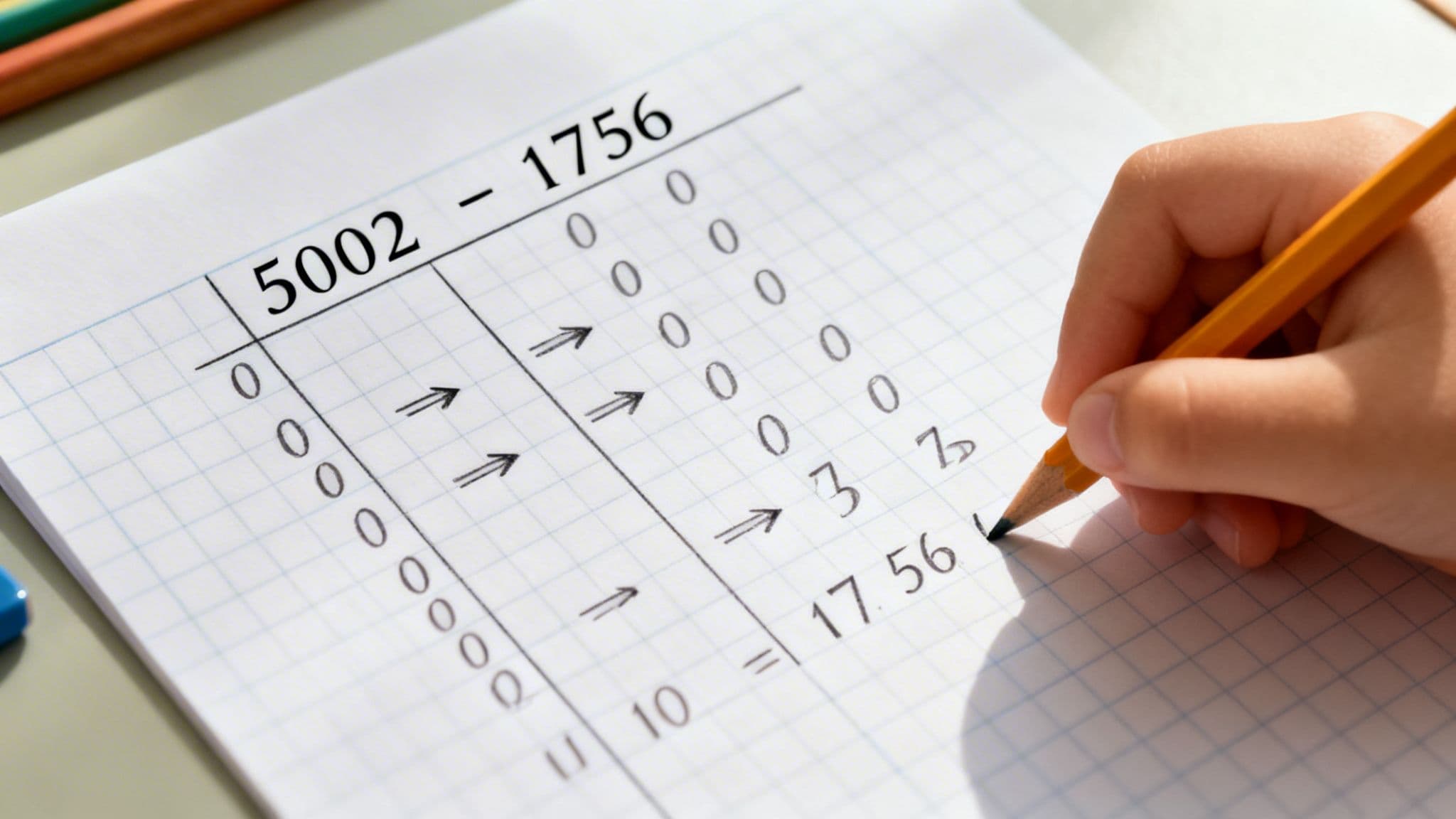
A classic gulp moment is 5002 - 1756. It looks intimidating because you need a “chain reaction” of exchanging across zeros. Teach the rule: go to the first column that actually has a value, then exchange step-by-step until the needed column has enough to subtract.
Applying Column Method Subtraction to Decimals
The most important rule when subtracting decimals is to align the decimal points.
For example, for £20.00 - £8.75, write the numbers so the decimal points line up exactly. Add placeholder zeros if needed (for example, write £5.50 not £5.5), then subtract from the right.
For dedicated practice, try subtract using column subtraction with larger numbers.
Common Mistakes and How to Help Your Child Fix Them
Even confident young mathematicians make a few predictable mistakes when they first tackle column subtraction. The trick is to spot them early and have a simple strategy ready.
Reversing the Subtraction
This happens when a child gets to a column where the top digit is smaller than the bottom one (like 2 - 5). Instead of exchanging, they flip it to 5 - 2. To fix it, get them to say the sum out loud: “You can't take 5 away from 2.”
Forgetting to Reduce After Exchanging
Another classic tripwire is exchanging successfully, but forgetting to reduce the number they borrowed from.
Quick tip: treat “cross out, reduce, carry over” as a single action.
Misaligning the Place Value Columns
Many wrong answers come from poor alignment, especially with different digit lengths (like 542 - 38). Squared paper helps massively.
Quick Fixes for Common Subtraction Errors
| Common Mistake | What It Looks Like | How to Help |
|---|---|---|
| Reversing the numbers | When faced with 42 - 17, they calculate 7 - 2. | Ask: “Can we take 7 from 2?” then prompt exchanging. |
| Forgetting to reduce | They borrow but don’t reduce the borrowed-from column. | Use a mantra: cross out, write the new number, carry over. |
| Column misalignment | Digits drift into the wrong place value columns. | Use squared paper (and draw column lines if needed). |
| Borrowing across zero | They get stuck on something like 304 - 127. | Remind them to go to the next available column. |
For more teaching ideas, see Twinkl’s teaching overview.
Your Questions About Column Subtraction Answered
What's the Difference Between Exchanging and Borrowing?
In short, there isn't one. They describe the exact same action, but most UK schools have moved towards “exchanging” because it’s a more accurate description of swapping one ten for ten ones.
My Child Finds Column Subtraction Stressful. How Can I Help?
Take a step back and make it physical: coins, LEGO, pasta shapes - anything that lets them exchange a “ten” for ten “ones”. Keep practice short (5-10 minutes) and focus on calm repetition.
When a child feels stressed, their working memory (crucial for multi-step problems like column subtraction) is reduced. Calm, untimed practice matters.
Why Can't My Child Just Use a Calculator?
Calculators aren't allowed in the KS2 SATs Arithmetic paper. More importantly, column subtraction builds number sense and fluency for later topics like decimals, fractions, and algebra.
For stress-free practice that builds confidence in small steps, explore Mindsharp at https://www.mindsharp.xyz.